



10 | Prognostic value of trans epidermal water loss in the treatment of actinic keratoses. A comparison amongst topical therapies for field cancerization
Matteo Bevilacqua, Filippo Fanetti, Nicolò Mori, Agata Janowska, Valentina Dini, Marco Romanelli | Department of Dermatology, University of Pisa, Pisa, Italy.

All claims expressed in this article are solely those of the authors and do not necessarily represent those of their affiliated organizations, or those of the publisher, the editors and the reviewers. Any product that may be evaluated in this article or claim that may be made by its manufacturer is not guaranteed or endorsed by the publisher.
Authors
Background: Actinic keratoses (AKs) are one of the most common premalignant skin conditions in the overall population. AKs are considered early precursors that may occasionally progress to squamous cell carcinoma. Patients commonly present multiple lesions alongside signs of chronic sun damage in surrounding skin, a condition often termed field cancerization. Several topical therapies for field cancerizations are available. Transepidermal water loss (TEWL) is a non-invasive diagnostic tool that can give objective measurements for evaluating skin barrier function by measuring the quantity of condensed water loss by the stratum corneum. Higher values can be associated with higher skin damage.
Methods: This observational prospective study included 103 patients affected by actinic keratoses (Olsen grade I and II) with a field cancerization up to 25 cm2. The were treated with either 5-fluorouracil (32 patients) , imiquimod (31) or tirbanibulin (36) in our department in Pisa. The TEWL values of the field cancerization were assessed at week 0,2,4,8 and 24 alongside the AKASI score for actinic keratosis severity. A TEWL value more than 15 was considered pathological and values over 23 were considered high.
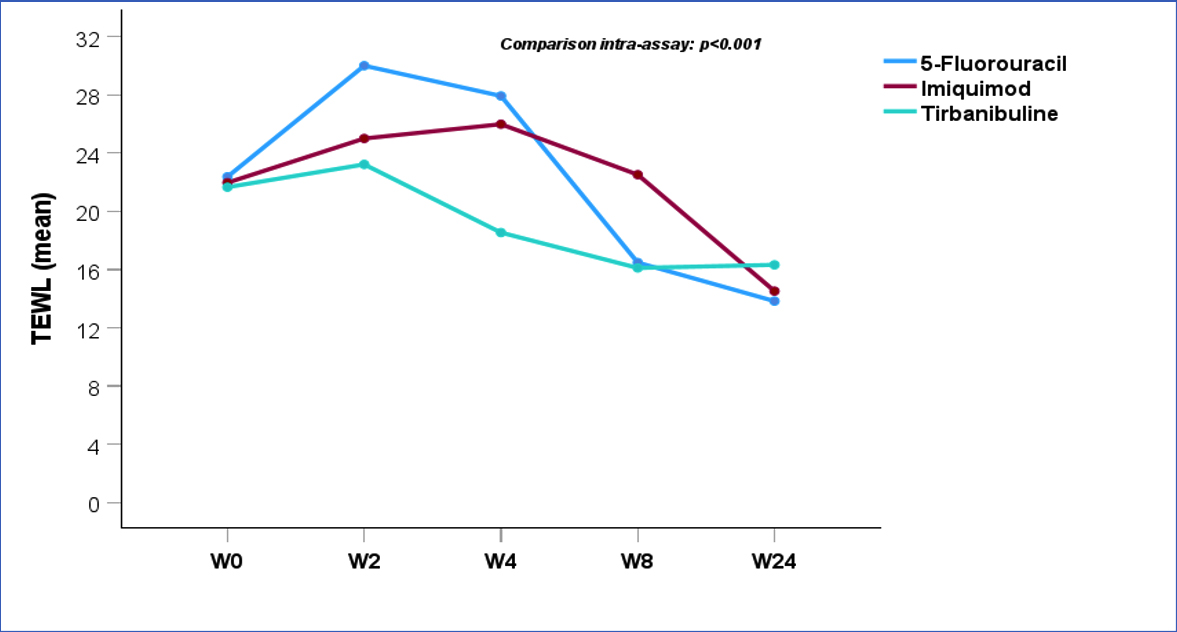
Results: Among the tirbanibulin subgroup (36), 17 patients presented TEWL > 23 and 6 (35%) had a complete resolution of the lesions; in the imiquimod subgroup (32), 15 patients presented TEWL > 23 and 10 (66%) had a complete resolution of the lesions; in the 5 fluorouracil subgroup (31), 19 patients presented TEWL > 23 and 16 (84%) had a complete resolution of the lesions. Pathological low TEWL values (15 > x < 23) were associated with a good clinical outcome in every subgroup (89% resolution outcome in the tirbanibulin group, 88% resolution outcome in the imiquimod group, 94% resolution outcome in the 5-fluorouracil group) (Figure 1). High AKASI score was associated with high TEWL values. Higher TEWL values at W2 and W4 were associated with more severe adverse events especially in the 5 fluorouracil group. Interestingly, patients that had a higher increase at W2 of TEWL values had a better chance of a good clinical outcome possibly indicating that a more intense inflammatory reaction could predict a resolution of the lesions.
Conclusions: This study shed some lights on the possible use of TEWL for the management of actinic keratoses. TEWL values could help physicians to chose the best therapeutic approach for field cancerization and to predict the possible outcome.
Figure 1.
Downloads
Citations



How to Cite

This work is licensed under a Creative Commons Attribution-NonCommercial 4.0 International License.
