

62° Congresso Nazionale ADOI, Firenze, 17-19 settembre 2026
Vol. 18 No. s1 (2026): 62° Congresso Nazionale ADOI, Firenze, 17-19 settembre 2026

22 | COMPLEX CUTANEOUS LEISHMANIASIS: A REPORT OF TWO CASES FROM THE DERMATOLOGY UNIT OF THE UNIVERSITY OF BOLOGNA, SANT’ORSOLA-MALPIGHI HOSPITAL
M. Ferrante1|2, M. La Placa 1|2, V. Gaspari1 | 1 Dermatology Unit, IRCCS Azienda Ospedaliero, Universitaria di Bologna, Policlinico S. Orsola-Malpighi, Bologna, Italy; 2 Department of Medical and Surgical Sciences, Alma Mater Studiorum, University of Bologna, Italy
Publisher's note
All claims expressed in this article are solely those of the authors and do not necessarily represent those of their affiliated organizations, or those of the publisher, the editors and the reviewers. Any product that may be evaluated in this article or claim that may be made by its manufacturer is not guaranteed or endorsed by the publisher.
All claims expressed in this article are solely those of the authors and do not necessarily represent those of their affiliated organizations, or those of the publisher, the editors and the reviewers. Any product that may be evaluated in this article or claim that may be made by its manufacturer is not guaranteed or endorsed by the publisher.
Published: 24 September 2026
0
Views
0
Downloads
Authors
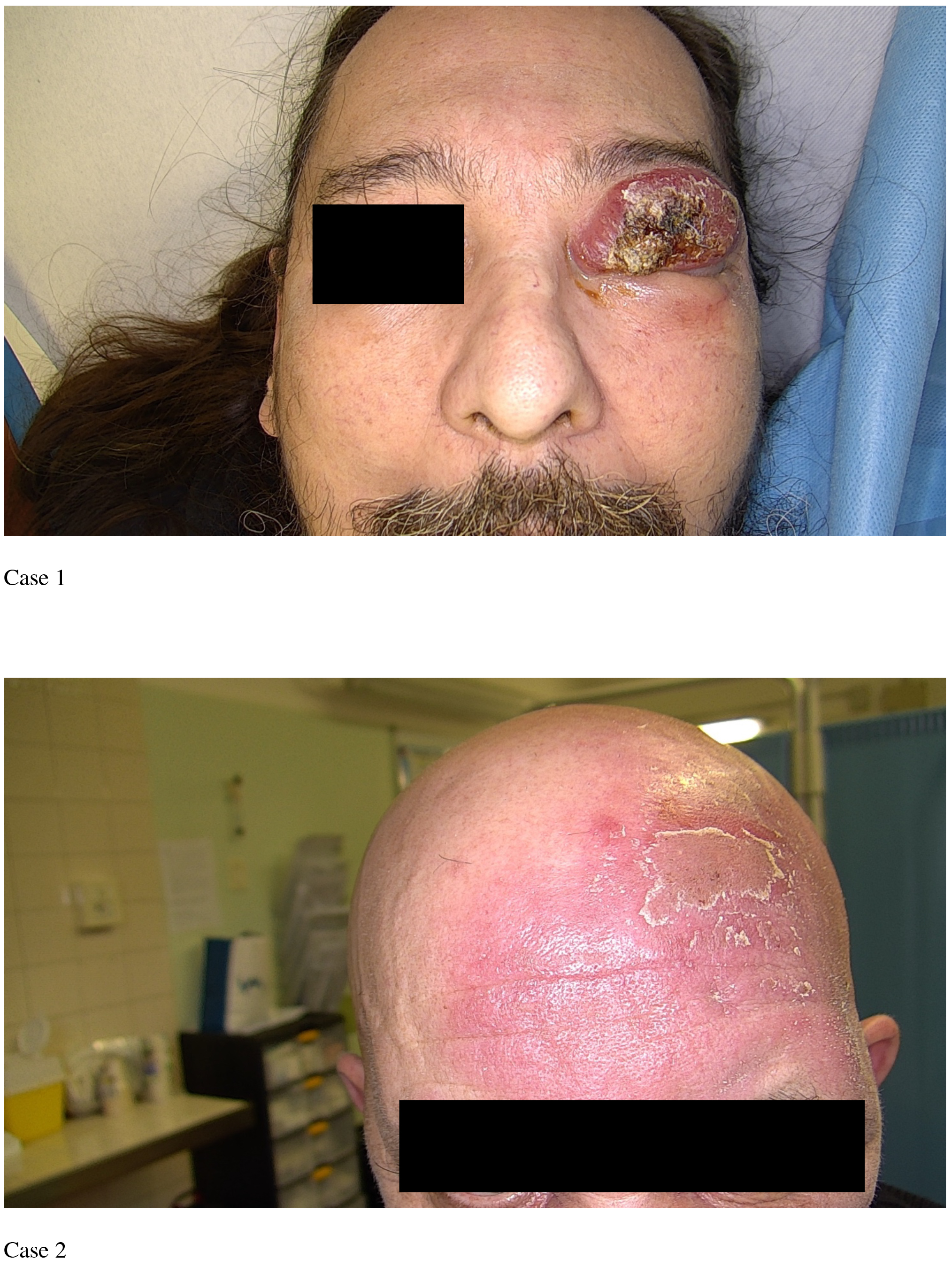
Materials and Methods. Two cases from IRCCS Policlinico Sant’Orsola-Malpighi (Bologna) are reported. Case 1: 55-year-old male, seen in January 2026 for a large erythematous-ulcerative-crusted swelling of the left upper eyelid, initially misdiagnosed as epithelioma. Case 2: 70-year-old male, presented in December 2022 with a large plaque on the forehead and scalp, initially interpreted as rosacea. In both immunocompetent patients, diagnosis was confirmed via histology and PCR after multiple therapy failures.
Results. A multidisciplinary protocol was established between Dermatology Unit and Infectious Diseases Department. Case 1: After initial failure of weekly intralesional (IL) injections of meglumine antimoniate and IV liposomal amphotericin B, the regimen was intensified by adding oral miltefosine and oral allopurinol. Resolution was achieved in 4 months with restored eyelid function, though plastic surgery was required for sequelae. Management was influenced by a schizoaffective disorder. Case 2: The patient faced long-term recurrences. After initial remission with IL injections of meglumine antimoniate, cryotherapy and oral miltefosine (later integrated with hydroxychloroquine), histologically confirmed relapses occurred in 2024 and 2025. This required an intensive protocol with IV pentamidine for one year, oral miltefosine for one month, and IL injections of meglumine antimoniate, reaching complete remission after 5 months.
Conclusions. CL misdiagnosis highlights a gap in early recognition, even in endemic areas. For critical sites or recurrent forms, no uniform therapy exists and treatment must be tailored to the individual . Success depends on early PCR diagnosis and specialist collaboration. A combined approach and prolonged follow-up are essential for parasite eradication and managing aesthetic-functional sequelae, minimizing recurrence risk.
Downloads
Download data is not yet available.
Citations



1. de Vries HJC, Schallig HD. Cutaneous Leishmaniasis: A 2022 Updated Narrative Review into Diagnosis and Management Developments. Am J Clin Dermatol. 2022 Nov;23(6):823-840. doi: 10.1007/s40257-022-00726-8. Epub 2022 Sep 14.
2. Blum J, Buffet P, Visser L, Harms G, Bailey MS, Caumes E, Clerinx J, van Thiel PP, Morizot G, Hatz C, Dorlo TP, Lockwood DN. LeishMan recommendations for treatment of cutaneous and mucosal leishmaniasis in travelers, 2014. J Travel Med. 2014 Mar-Apr;21(2):116-29. doi: 10.1111/jtm.12089.
3. Todeschini R, Musti MA, Pandolfi P, Troncatti M, Baldini M, Resi D, Natalini S, Bergamini F, Galletti G, Santi A, Rossi A, Rugna G, Granozzi B, Attard L, Gaspari V, Liguori G, Ortalli M, Varani S. Re-emergence of human leishmaniasis in northern Italy, 2004 to 2022: a retrospective analysis. Euro Surveill. 2024 Jan;29(4):2300190. doi: 10.2807/1560-7917.ES.2024.29.4.2300190.
How to Cite
1.
22 | COMPLEX CUTANEOUS LEISHMANIASIS: A REPORT OF TWO CASES FROM THE DERMATOLOGY UNIT OF THE UNIVERSITY OF BOLOGNA, SANT’ORSOLA-MALPIGHI HOSPITAL: M. Ferrante1|2, M. La Placa 1|2, V. Gaspari1 | 1 Dermatology Unit, IRCCS Azienda Ospedaliero, Universitaria di Bologna, Policlinico S. Orsola-Malpighi, Bologna, Italy; 2 Department of Medical and Surgical Sciences, Alma Mater Studiorum, University of Bologna, Italy. Dermatol Reports [Internet]. 2026 Sep. 24 [cited 2026 Sep. 24];18(s1). Available from: https://journals.pagepress.net/dr/article/view/11063
Copyright (c) 2026 The Author(s)


This work is licensed under a Creative Commons Attribution-NonCommercial 4.0 International License.
