


62° Congresso Nazionale ADOI, Firenze, 17-19 settembre 2026
Vol. 18 No. s1 (2026): 62° Congresso Nazionale ADOI, Firenze, 17-19 settembre 2026

55 | PAEDIATRIC FOLLICULAR MUCINOSIS WITHOUT PROGRESSION TO MYCOSIS FUNGOIDES: A LONG-TERM CLINICOPATHOLOGIC STUDY
A. Di Guardo1, L. Ambrosio1|2, M. Testa1, D. Didona1, F. Moro1|2, A. Rallo1, G. Di Lella1, L. Colonna1, S. Pallotta1, A. Panebianco1, L. Fania1|3 | 1IDI-IRCCS, Dermatological Research Hospital, Rome, Italy; 2UOC of Dermatology, Department of Medical and Cardiovascular Sciences, “Sapienza” University of Rome, Italy; 3Department of Life Science, Health, and Health Professions, Link University of Rome, Italy
Publisher's note
All claims expressed in this article are solely those of the authors and do not necessarily represent those of their affiliated organizations, or those of the publisher, the editors and the reviewers. Any product that may be evaluated in this article or claim that may be made by its manufacturer is not guaranteed or endorsed by the publisher.
All claims expressed in this article are solely those of the authors and do not necessarily represent those of their affiliated organizations, or those of the publisher, the editors and the reviewers. Any product that may be evaluated in this article or claim that may be made by its manufacturer is not guaranteed or endorsed by the publisher.
Published: 24 September 2026
0
Views
0
Downloads
Authors
Materials and Methods. We performed a retrospective single-center study including patients aged <18 years diagnosed with FM at a tertiary dermatology referral center in Italy between 2003 and 2026. Demographic, clinical, histopathologic, molecular, treatment, and outcome data were collected from medical records. Histopathologic features, including folliculotropism and epidermotropism, were recorded.
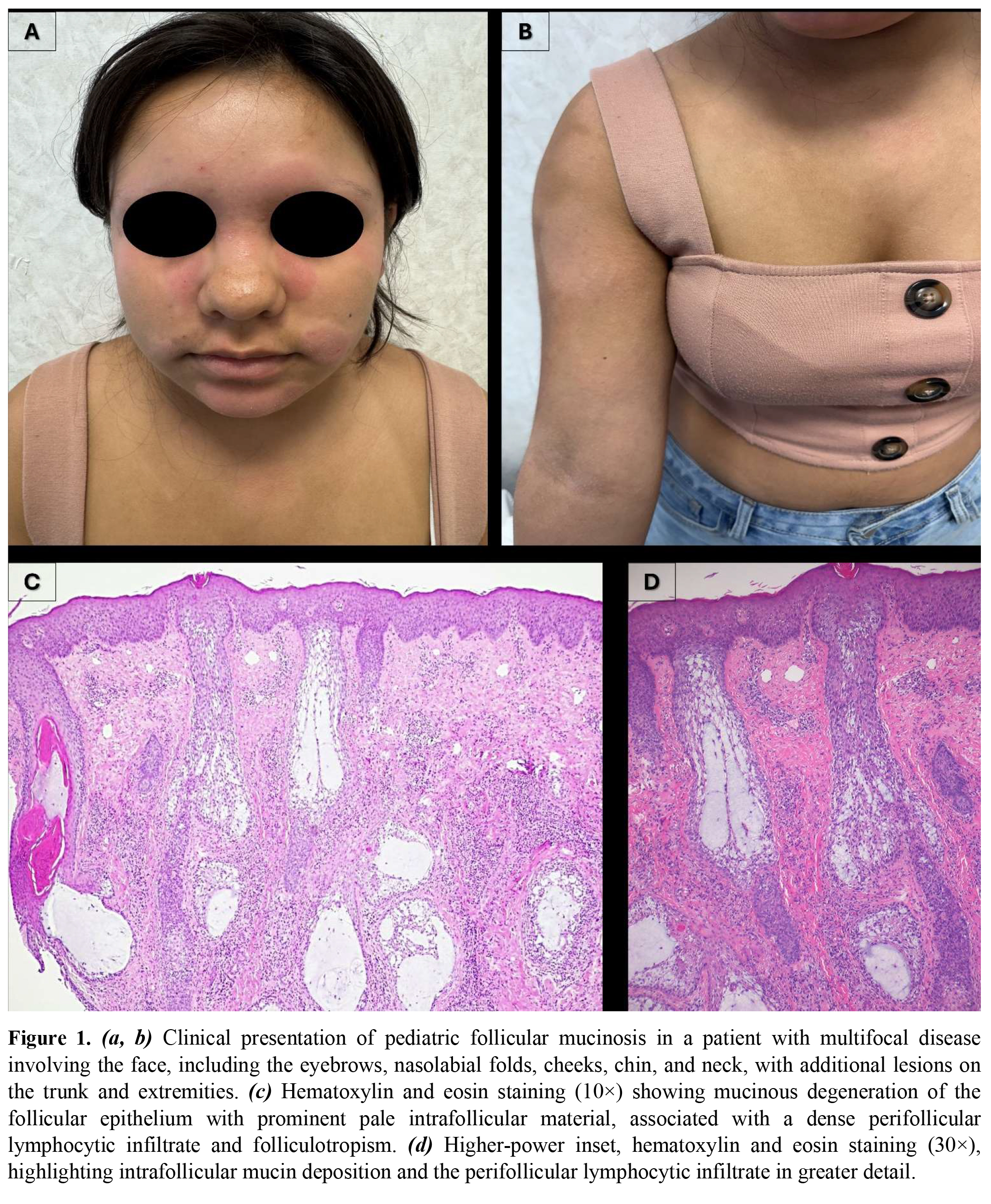
Results. Twenty-three pediatric patients were included: 14 males (60.9%) and 9 females (39.1%), with a mean age at presentation of 12.6 ± 3.0 years. The head and neck region was involved in 21 cases (91.3%) and represented the only affected site in 16 patients (69.6%). Histopathology showed folliculotropism in 16/23 cases (69.6%) and epidermotropism in 13/23 (56.5%), with both features present in 8 patients (34.8%). TCR analysis was available in 12 cases: 8 were negative, 2 polyclonal, and 2 monoclonal. Treatment was mainly conservative and skin-directed, most frequently topical corticosteroids (14/23, 60.9%). At last follow-up, all 12 evaluable patients had achieved CR. No patient with available follow-up progressed to MF.
Conclusions. Pediatric FM in this cohort showed favorable long-term outcomes, frequent complete remission over time, and no progression to MF among evaluable patients in line with previous pediatric series supporting an indolent course [4,5]. Folliculotropism, epidermotropism, or TCR monoclonality should not be interpreted in isolation as evidence of lymphoma. Conservative management with structured clinicopathologic follow-up appears appropriate for most children, while repeat biopsy and closer surveillance should be reserved for persistent, recurrent, extensive, or clinically atypical disease.
Downloads
Download data is not yet available.
Citations



1. Khalil J, Kurban M, Abbas O. Follicular mucinosis: a review. Int J Dermatol. 2021 Feb;60(2):159-165.
2. Gibson LE, Muller SA, Leiferman KM, Peters MS. Follicular mucinosis: clinical and histopathologic study. J Am Acad Dermatol. 1989 Mar;20(3):441-446.
3. Pinkus H. Alopecia mucinosa; inflammatory plaques with alopecia characterized by root-sheath mucinosis. AMA Arch Derm. 1957;76:419-424.
4. Jin MF, Ali NS, Davis DMR, Johnson EF, Gibson LE. An update on long-term outcomes of pediatric follicular mucinosis over a 20-year period: a retrospective cohort study. Int J Dermatol. 2023 Aug;62(8):1056-1059.
5. Zvulunov A, Shkalim V, Ben-Amitai D, Feinmesser M. Clinical and histopathologic spectrum of alopecia mucinosa/follicular mucinosis and its natural history in children. J Am Acad Dermatol. 2012 Dec;67(6):1174-1181.
How to Cite
1.
55 | PAEDIATRIC FOLLICULAR MUCINOSIS WITHOUT PROGRESSION TO MYCOSIS FUNGOIDES: A LONG-TERM CLINICOPATHOLOGIC STUDY: A. Di Guardo1, L. Ambrosio1|2, M. Testa1, D. Didona1, F. Moro1|2, A. Rallo1, G. Di Lella1, L. Colonna1, S. Pallotta1, A. Panebianco1, L. Fania1|3 | 1IDI-IRCCS, Dermatological Research Hospital, Rome, Italy; 2UOC of Dermatology, Department of Medical and Cardiovascular Sciences, “Sapienza” University of Rome, Italy; 3Department of Life Science, Health, and Health Professions, Link University of Rome, Italy. Dermatol Reports [Internet]. 2026 Sep. 24 [cited 2026 Sep. 25];18(s1). Available from: https://journals.pagepress.net/dr/article/view/11069
Copyright (c) 2026 The Author(s)


This work is licensed under a Creative Commons Attribution-NonCommercial 4.0 International License.
