

62° Congresso Nazionale ADOI, Firenze, 17-19 settembre 2026
Vol. 18 No. s1 (2026): 62° Congresso Nazionale ADOI, Firenze, 17-19 settembre 2026

32 | BEYOND AREA REDUCTION: PULSED DYE LASER TREATMENT OF BASAL CELL CARCINOMA IN A PRELIMINARY REAL-WORLD COHORT
G. Frattin1|2, A. Bolzon1|2, E. Pezzolo1, L. Germi1, L. Gnesotto1, A. Corrà1, G. Mioso1, Z. Fratton1, L. Schiesari1 | 1UOC Dermatologia, Ospedale San Bortolo, Vicenza, Italy; 2Università degli Studi di Padova, Clinica Dermatologica, Italy
Publisher's note
All claims expressed in this article are solely those of the authors and do not necessarily represent those of their affiliated organizations, or those of the publisher, the editors and the reviewers. Any product that may be evaluated in this article or claim that may be made by its manufacturer is not guaranteed or endorsed by the publisher.
All claims expressed in this article are solely those of the authors and do not necessarily represent those of their affiliated organizations, or those of the publisher, the editors and the reviewers. Any product that may be evaluated in this article or claim that may be made by its manufacturer is not guaranteed or endorsed by the publisher.
Published: 24 September 2026
0
Views
0
Downloads
Authors
Methods. We analyzed a preliminary real-world cohort of patients with histologically confirmed primary BCC treated with 595-nm PDL. Baseline variables included age, lesion site, histologic subtype, risk area, maximum diameter, calculated elliptical area, and clinically measured thickness for nodular lesions. Treatment parameters, pain visual analogue scale (VAS), adverse events, clinical and dermoscopic clearance, and morphometric changes were recorded. For nodular BCCs, thickness reduction was calculated by comparing each lesion at baseline and latest follow-up.
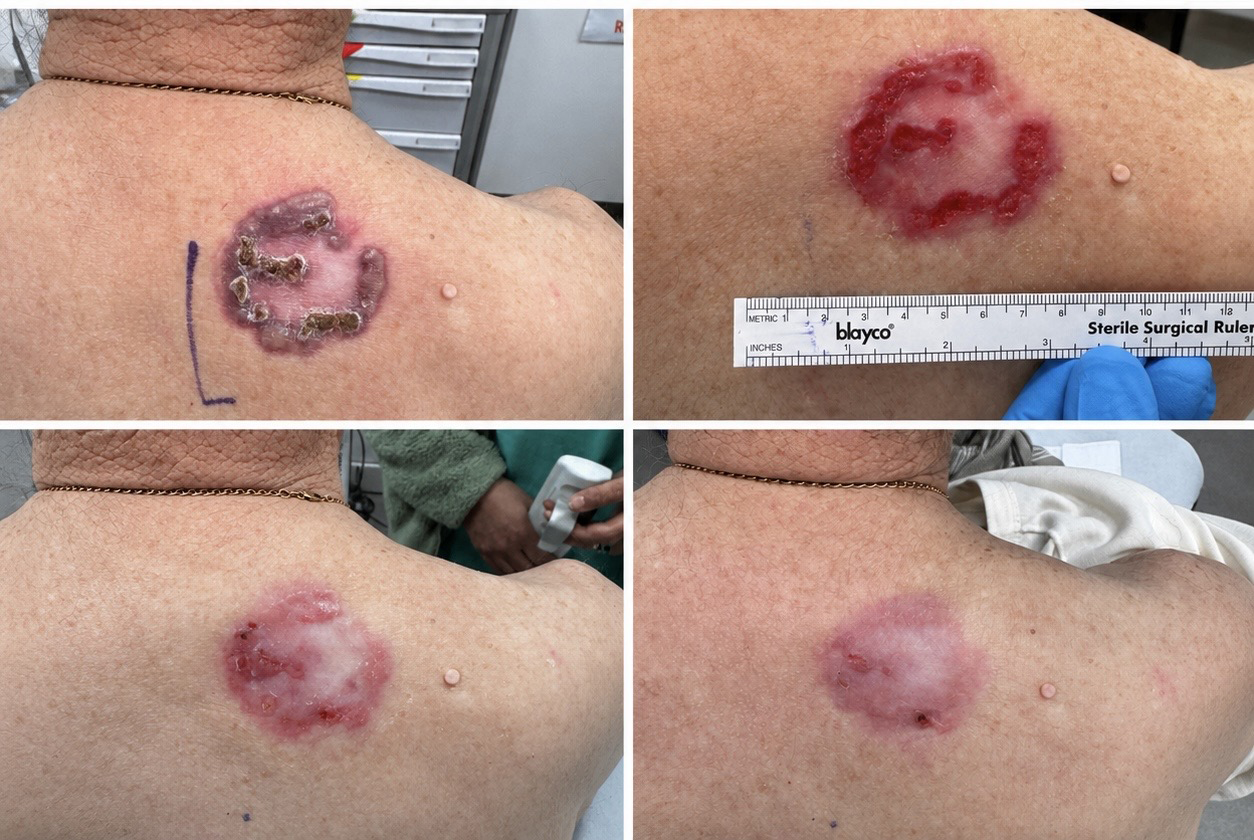
Results. Seventeen patients with 26 primary BCCs were included: 13 superficial and 13 nodular. Patients were predominantly older, with a mean age of 72.4 years, and several lesions were treated in a context of surgically difficult or infeasible management. Twelve lesions had follow-up assessment. At latest follow-up, mean area reduction was 40.6% overall. Superficial BCCs showed greater area reduction than nodular BCCs (59.7% vs 21.5%), with complete or partial clinical and dermoscopic clearance in all evaluable superficial lesions. Conversely, nodular BCCs showed modest area reduction but marked thickness decrease, with mean and median percentage reductions of 49.4% and 45.0%. Treatment was well tolerated, with mean pain VAS of 1.44/10, no anesthesia, and no major adverse events. Two minor bleeding events were recorded during follow-up.
Conclusions. In this preliminary cohort, 595-nm PDL showed a favorable tolerability and safety profile in selected BCCs, particularly in older patients and surgically challenging cases. Superficial BCCs showed greater area reduction and higher clinical and dermoscopic response than nodular lesions. The main innovative finding is that, in nodular BCCs, thickness reduction was substantially greater than area reduction, suggesting that conventional area-based endpoints may underestimate response. Subtype-specific morphometric assessment, including thickness measurement, may improve response evaluation in future PDL studies.
Downloads
Download data is not yet available.
Citations



1. Abo Zaken G, Fatirkhorani R, Rodriguez B, Garcia-Sellek B. Pulsed dye laser (PDL) in the treatment of basal cell carcinoma: a review. Lasers Med Sci. 2025;40:466.
2. Clementi A, Cannarozzo G, Guarino L, et al. Laser therapy in basal cell carcinoma: current evidence, literature gaps and future perspectives. Bioengineering. 2026;13:244.
3. Baran KL, Cheung TC, Csank GA, Michaels BM. Pulsed dye laser for treatment of basal cell carcinoma. Plast Reconstr Surg Glob Open. 2023;11:e4850.
How to Cite
1.
32 | BEYOND AREA REDUCTION: PULSED DYE LASER TREATMENT OF BASAL CELL CARCINOMA IN A PRELIMINARY REAL-WORLD COHORT: G. Frattin1|2, A. Bolzon1|2, E. Pezzolo1, L. Germi1, L. Gnesotto1, A. Corrà1, G. Mioso1, Z. Fratton1, L. Schiesari1 | 1UOC Dermatologia, Ospedale San Bortolo, Vicenza, Italy; 2Università degli Studi di Padova, Clinica Dermatologica, Italy. Dermatol Reports [Internet]. 2026 Sep. 24 [cited 2026 Sep. 24];18(s1). Available from: https://journals.pagepress.net/dr/article/view/11093
Copyright (c) 2026 The Author(s)


This work is licensed under a Creative Commons Attribution-NonCommercial 4.0 International License.
