

62° Congresso Nazionale ADOI, Firenze, 17-19 settembre 2026
Vol. 18 No. s1 (2026): 62° Congresso Nazionale ADOI, Firenze, 17-19 settembre 2026

56 | FIRST-LINE EXTRACORPOREAL PHOTOPHERESIS PLUS INTERFERON-Α IN SÉZARY SYNDROME: REAL-WORLD SURVIVAL AND EXPLORATORY BLOOD BIOMARKERS
A. Di Guardo1, M.P. Accetturi1, C. Cristofoletti1, A. Frezzolini1, E. Scala1, L. Fania1|2, A. Monopoli1, M.G. Narducci1 | 1IDI-IRCCS, Dermatological Research Hospital, Italy; 2Department of Life Science, Health, and Health Professions, Link University of Rome, Italy
Publisher's note
All claims expressed in this article are solely those of the authors and do not necessarily represent those of their affiliated organizations, or those of the publisher, the editors and the reviewers. Any product that may be evaluated in this article or claim that may be made by its manufacturer is not guaranteed or endorsed by the publisher.
All claims expressed in this article are solely those of the authors and do not necessarily represent those of their affiliated organizations, or those of the publisher, the editors and the reviewers. Any product that may be evaluated in this article or claim that may be made by its manufacturer is not guaranteed or endorsed by the publisher.
Published: 24 September 2026
0
Views
0
Downloads
Authors
Materials and Methods. We conducted a retrospective single-center survival analysis of 72 consecutive patients with SS treated with first-line ECP plus IFN-α between 2000 and 2023. Patients were stratified according to extreme survival outcomes. Blood tumor burden was assessed by flow cytometry using a TCR Vβ repertoire kit combined with anti-CD3 and anti-CD4 antibodies. When applicable, Sézary cells were also identified by the aberrant immunophenotypic profile.³
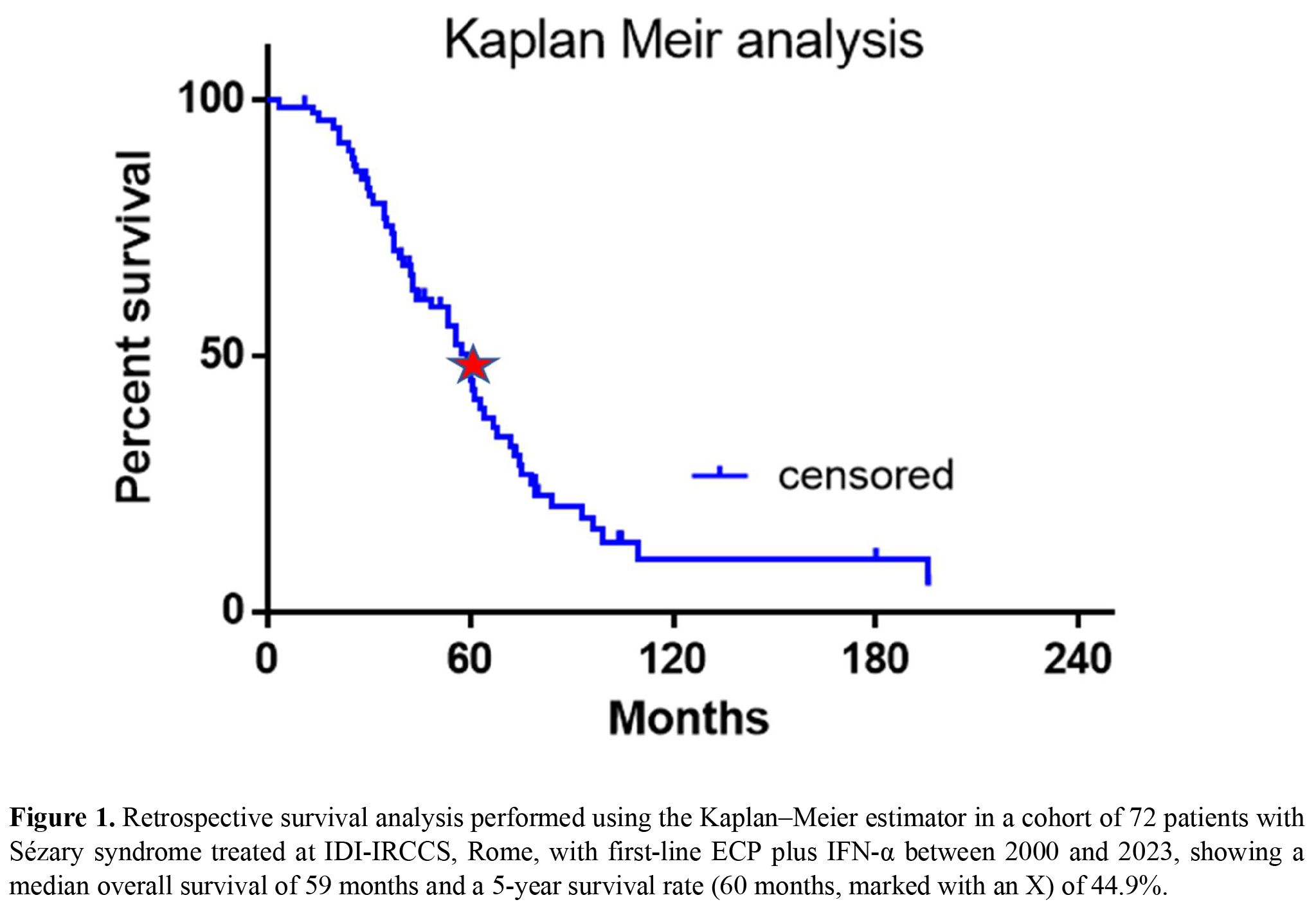
Results. The cohort included 72 patients, with a median age at diagnosis of 69 years; 39 were female and 33 male. Median treatment duration with ECP plus IFN-α was 18 months. Kaplan–Meier analysis showed a median OS of 59 months and a 5-year survival rate of 44.9%. Thirteen long survivors, defined by OS >80 months, and 13 poor survivors, defined by OS <30 months, were identified. Long survivors showed an early and statistically significant reduction of the expanded TCR Vβ clone after treatment initiation, suggesting rapid decline of circulating clonal tumor burden. They also more frequently achieved normalization of the TCR Vβ repertoire during follow-up, whereas poor survivors more often showed persistent clonal expansion.
Conclusions. In this real-world cohort, first-line ECP combined with IFN-α was associated with meaningful long-term survival in SS. The 5-year OS observed appears to lie at the upper end of previously reported ranges, possibly reflecting the role of tertiary-care management, careful blood monitoring and timely treatment initiation. Early reduction of the expanded TCR Vβ clone and subsequent normalization of the TCR Vβ profile may represent practical candidate biomarkers of sustained benefit and prolonged survival, although confirmation in larger prospective cohorts is required.
Downloads
Download data is not yet available.
Citations



1. Willemze R, Jaffe ES, Burg G, Cerroni L, Berti E, Swerdlow SH, Ralfkiaer E, Chimenti S, Diaz-Perez JL, Duncan LM, et al. WHO-EORTC classification for cutaneous lymphomas. Blood. 2005 May 15;105(10):3768-85.
2. Scarisbrick JJ, Prince HM, Vermeer MH, Quaglino P, Horwitz S, Porcu P, Stadler R, Wood GS, Beylot-Barry M, Pham-Ledard A, et al. Cutaneous Lymphoma International Consortium Study of Outcome in Advanced Stages of Mycosis Fungoides and Sézary Syndrome: Effect of Specific Prognostic Markers on Survival and Development of a Prognostic Model. J Clin Oncol. 2015 Nov 10;33(32):3766-73.
3. Scala E, Abeni D, Pomponi D, Narducci MG, Lombardo GA, Mari A, Frontani M, Picchio MC, Pilla MA, et al. The role of 9-O-acetylated ganglioside D3 (CD60) and {alpha}4{beta}1 (CD49d) expression in predicting the survival of patients with Sezary syndrome. Haematologica. 2010 Nov;95(11):1905-12.
4. Gao C, McCormack C, van der Weyden C, Goh MS, Campbell BA, Twigger R, Buelens O, Harrison SJ, Khoo C, Lade S, et al. Prolonged survival with the early use of a novel extracorporeal photopheresis regimen in patients with Sézary syndrome. Blood. 2019 Oct 17;134(16):1346-1350.
5. Ling YL, Huang X, Mitri G, Lovelace B, Pham A, Knobler R, Li X, Gao X. Real-world use of extracorporeal photopheresis for patients with cutaneous T-cell lymphoma in the United States: 2010-2015. J Dermatolog Treat. 2020 Feb;31(1):91-98.
How to Cite
1.
56 | FIRST-LINE EXTRACORPOREAL PHOTOPHERESIS PLUS INTERFERON-Α IN SÉZARY SYNDROME: REAL-WORLD SURVIVAL AND EXPLORATORY BLOOD BIOMARKERS: A. Di Guardo1, M.P. Accetturi1, C. Cristofoletti1, A. Frezzolini1, E. Scala1, L. Fania1|2, A. Monopoli1, M.G. Narducci1 | 1IDI-IRCCS, Dermatological Research Hospital, Italy; 2Department of Life Science, Health, and Health Professions, Link University of Rome, Italy. Dermatol Reports [Internet]. 2026 Sep. 24 [cited 2026 Sep. 25];18(s1). Available from: https://journals.pagepress.net/dr/article/view/11106
Copyright (c) 2026 The Author(s)


This work is licensed under a Creative Commons Attribution-NonCommercial 4.0 International License.
