

62° Congresso Nazionale ADOI, Firenze, 17-19 settembre 2026
Vol. 18 No. s1 (2026): 62° Congresso Nazionale ADOI, Firenze, 17-19 settembre 2026

67 | LEBRIKIZUMAB FOR PAEDIATRIC PATIENTS AGED ≥6 MONTHS WITH MODERATE-TO-SEVERE AD: PHASE 3 ADORABLE-1 WEEK-16 RESULTS
L. Stingeni1, L. Eichenfield2, J. Ornelas3, V. Prajapati4, C. Yang5, A. Tanaka6, S. Weidinger7, C. Flohr8, E. Swanson9, L. Martin10, S. Daveiga11, R. Gontijo Lima11, H. Elmaraghy11, E. Pierce11, P. Sen11, G. Gallo11, M. Piruzeli11, A. Larkin11, M. Grau12, Y. Mihaylov12, A. Paller13 | 1Dermatology Section, Department of Medicine and Surgery, University of Perugia, Italy; 2Departments of Dermatology and Pediatrics, University of California San Diego School of Medicine, La Jolla, California, USA; 3Department of Dermatology, Integrative Skin Science and Research, Sacramento, California, USA; 4Dermatology Research Institute, Skin Health & Wellness Centre, Probity Medical Research, and University of Calgary, Calgary, Canada; 5Chang Gung University College of Medicine, Taoyuan, Taiwan; 6Department of Dermatology, Graduate School of Biomedical and Health Sciences, Hiroshima University, Hiroshima, Japan; 7Department of Dermatology and Allergy, University Hospital Schleswig-Holstein, Kiel, Lübeck, Germany; 8Department of Dermatology and Population Health Sciences, King’s College London, UK; 9Ada West Dermatology, St Luke’s Children’s Hospital Idaho, USA; 10School of Clinical Medicine, UNSW Sydney & Dermatology Department, Sydney Children’s Hospital, Sydney, Australia; 11Eli Lilly and Company, Indianapolis, Indiana, USA; 12Almirall R&D, S.A., Barcelona, Spain; 13Dermatology and Infectious Disease, Feinberg School of Medicine, Northwestern University, Chicago, Illinois, USA
Publisher's note
All claims expressed in this article are solely those of the authors and do not necessarily represent those of their affiliated organizations, or those of the publisher, the editors and the reviewers. Any product that may be evaluated in this article or claim that may be made by its manufacturer is not guaranteed or endorsed by the publisher.
All claims expressed in this article are solely those of the authors and do not necessarily represent those of their affiliated organizations, or those of the publisher, the editors and the reviewers. Any product that may be evaluated in this article or claim that may be made by its manufacturer is not guaranteed or endorsed by the publisher.
Published: 24 September 2026
0
Views
0
Downloads
Authors
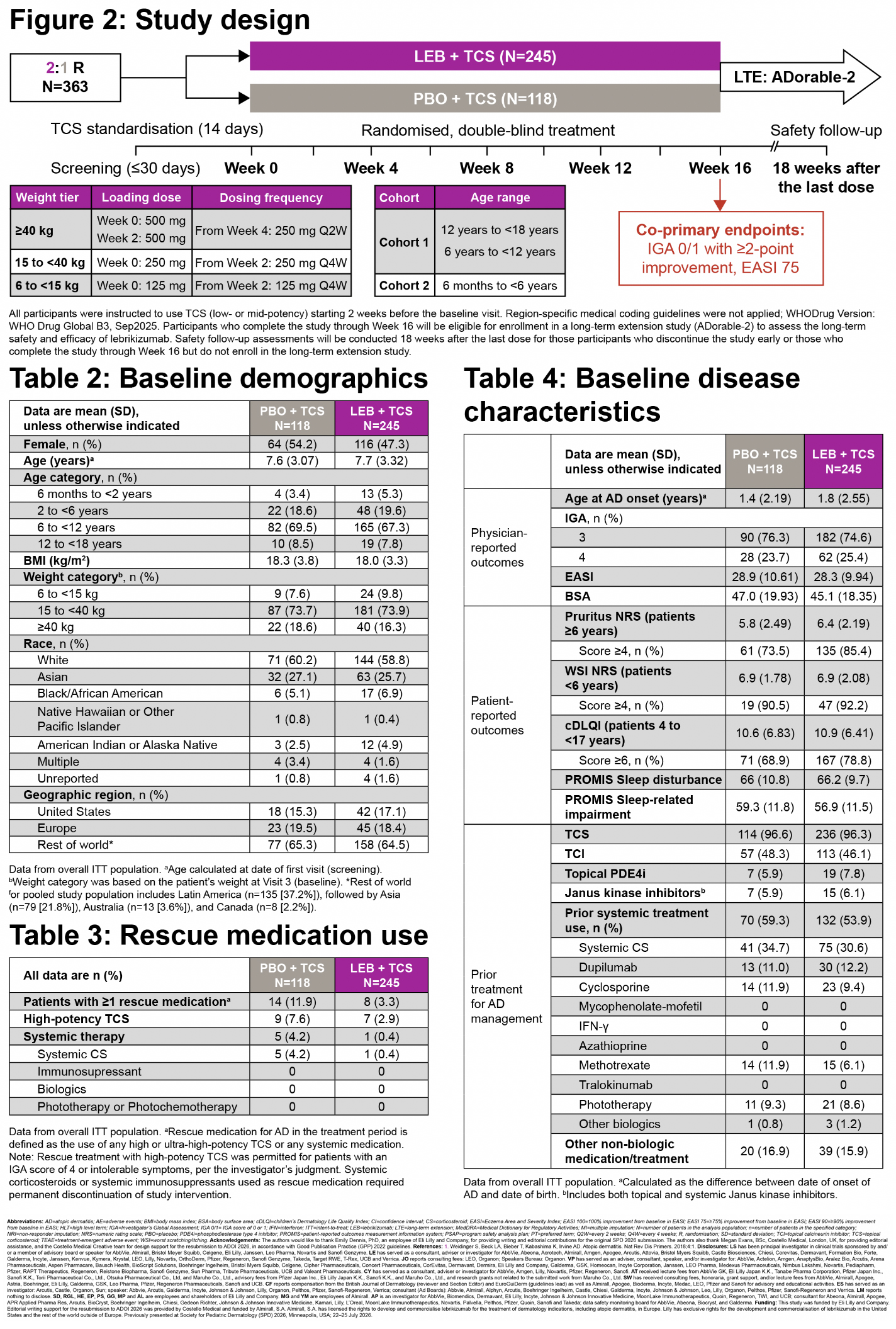
Methods. Key inclusion criteria. Age ≥6 months to <18 years. Weight minimum ≥6 kg for all patients, and <40 kg for patients aged ≥12 to <18 years. EASI score ≥16. IGA score ≥3 (on a 0–4 scale). ≥10% body surface area (BSA) involvement. Diagnosis of AD per American Academy of Dermatology criteria, with duration requirements tiered by age: – ≥12 months if the participant was ≥6 years old – ≥6 months if 2 to <6 years old – ≥3 months if 6 months to <2 years old Key exclusion criteria. Prior treatments before baseline: – Dupilumab within 8 weeks (enrollment of patients with prior dupilumab use was capped at <20% of the study population) – Other biologics within 5 half-lives (if known) or 16 weeks, whichever is longer TCS standardisation. Two weeks before the baseline visit, a standardised topical corticosteroid (TCS) treatment was initiated for all patients and continued through the end of the study. TCS use was tapered upon lesion clearance (IGA ≤2 → 3×/week; IGA 0 → stop), alongside daily non-medicated emollient use throughout the study Rescue medication. Rescue medication included high or ultra-high-potency TCS, and any systemic AD treatment Analysis populations. Efficacy analyses used the overall Intent-to-Treat (ITT) population. Safety analyses used the Overall Safety population Statistical analyses. Treatment comparisons used the Cochran‑Mantel‑Haenszel test stratified by geographic region, age group at first visit and disease severity. Primary method of handling missing efficacy data (non-responder imputation/multiple imputation [NRI/MI]): – Patients who received rescue medication were analysed as non-responders – For patients who discontinued treatment for any reason, observed data after treatment discontinuation were used; Markov chain Monte Carlo multiple imputation was used to handle the remaining missing data. The family-wise type 1 error is controlled at a 2-sided level of 0.05 using the graphical multiple testing strategy. The overall ITT population is defined as all randomised patients from Cohort 1 and all randomised patients from Cohort 2 who either complete or have an opportunity to complete treatment through Week 16 at the time of the data cut. The Overall Safety population is defined as all randomised patients from Cohorts 1 and 2 who received ≥1 dose of study treatment and who either complete or have an opportunity to complete treatment through Week 16.
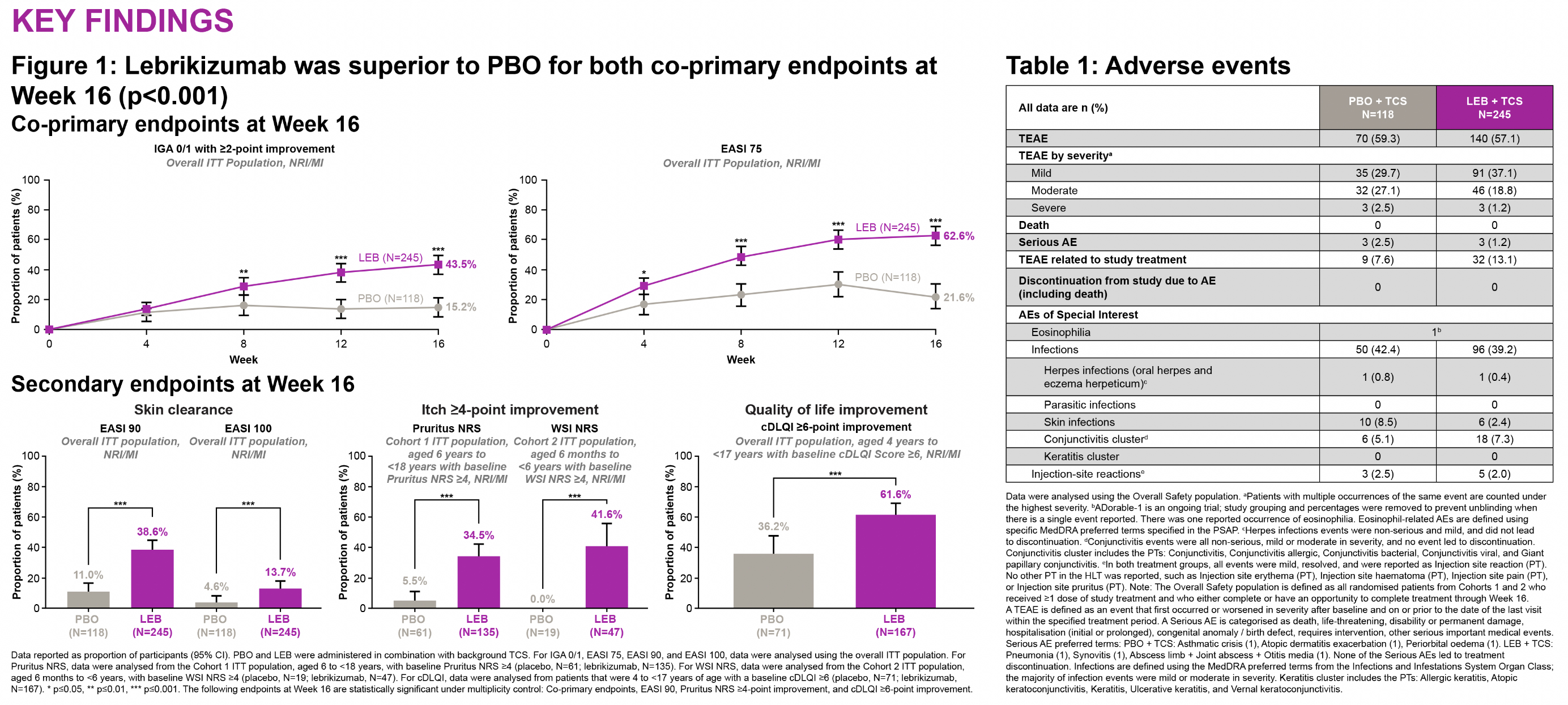
Conclusions. In the Phase 3 ADorable‑1 study, lebrikizumab demonstrated statistically significant and clinically meaningful efficacy versus PBO, meeting both co‑primary endpoints of Investigator’s Global Assessment (IGA) 0/1 with ≥2-point improvement and Eczema Area And Severity Index (EASI) 75 at Week 16 in patients aged 6 months to <18 years with moderate‑to‑severe AD. Treatment with lebrikizumab resulted in consistent improvements in key measures of disease severity and symptoms (skin clearance, itch relief and quality of life). The safety profile of lebrikizumab in ADorable-1 was consistent with prior studies in adult and adolescent patients with moderate-to-severe AD, and no new safety findings were identified over 16 weeks of treatment. These results provide evidence supporting interleukin-13-targeted therapy as a novel treatment for a broad paediatric population.
Downloads
Download data is not yet available.
Citations



How to Cite
1.
67 | LEBRIKIZUMAB FOR PAEDIATRIC PATIENTS AGED ≥6 MONTHS WITH MODERATE-TO-SEVERE AD: PHASE 3 ADORABLE-1 WEEK-16 RESULTS: L. Stingeni1, L. Eichenfield2, J. Ornelas3, V. Prajapati4, C. Yang5, A. Tanaka6, S. Weidinger7, C. Flohr8, E. Swanson9, L. Martin10, S. Daveiga11, R. Gontijo Lima11, H. Elmaraghy11, E. Pierce11, P. Sen11, G. Gallo11, M. Piruzeli11, A. Larkin11, M. Grau12, Y. Mihaylov12, A. Paller13 | 1Dermatology Section, Department of Medicine and Surgery, University of Perugia, Italy; 2Departments of Dermatology and Pediatrics, University of California San Diego School of Medicine, La Jolla, California, USA; 3Department of Dermatology, Integrative Skin Science and Research, Sacramento, California, USA; 4Dermatology Research Institute, Skin Health & Wellness Centre, Probity Medical Research, and University of Calgary, Calgary, Canada; 5Chang Gung University College of Medicine, Taoyuan, Taiwan; 6Department of Dermatology, Graduate School of Biomedical and Health Sciences, Hiroshima University, Hiroshima, Japan; 7Department of Dermatology and Allergy, University Hospital Schleswig-Holstein, Kiel, Lübeck, Germany; 8Department of Dermatology and Population Health Sciences, King’s College London, UK; 9Ada West Dermatology, St Luke’s Children’s Hospital Idaho, USA; 10School of Clinical Medicine, UNSW Sydney & Dermatology Department, Sydney Children’s Hospital, Sydney, Australia; 11Eli Lilly and Company, Indianapolis, Indiana, USA; 12Almirall R&D, S.A., Barcelona, Spain; 13Dermatology and Infectious Disease, Feinberg School of Medicine, Northwestern University, Chicago, Illinois, USA. Dermatol Reports [Internet]. 2026 Sep. 24 [cited 2026 Sep. 24];18(s1). Available from: https://journals.pagepress.net/dr/article/view/11114
Copyright (c) 2026 The Author(s)


This work is licensed under a Creative Commons Attribution-NonCommercial 4.0 International License.
