



08 | Cutaneous melanoma and occupational UV exposure: associations with anatomical site, histological subtype, and Breslow thickness
Federica Fazzari, Giovanni Cecchi, Gabriella Perill, Biancamaria Zuccaro, Vincenzo De Giorgi | Department of Health Sciences, Section of Dermatology, University of Florence, Florence, Italy.

All claims expressed in this article are solely those of the authors and do not necessarily represent those of their affiliated organizations, or those of the publisher, the editors and the reviewers. Any product that may be evaluated in this article or claim that may be made by its manufacturer is not guaranteed or endorsed by the publisher.
Authors
Background: The relationship between occupational sun exposure and melanoma risk is complex and multifactorial, with conflicting evidence in the literature. Unlike non-melanoma skin cancers (NMSC), for which occupational sun exposure is a well-established risk factor, the association with cutaneous melanoma remains controversial.
Methods: We conducted a retrospective cohort analysis to evaluate whether occupational sun exposure represents a risk factor for cutaneous melanoma, with particular focus on histological subtype, anatomical site, and Breslow thickness. Patients diagnosed between January 2005 and October 2023 at the Dermatology Unit, Azienda USL Toscana Centro, Florence, were included. Occupational ultraviolet (UV) exposure was assessed by classifying each participant’s occupation into three categories: outdoor (e.g., agriculture, construction), mixed indoor/outdoor (e.g., artisans, law enforcement), and indoor (e.g., office work).
Results: A total of 1417 patients were analyzed. Occupational categorization showed that 1171 patients (82.64%) belonged to the non-exposed group (indoor), while 246 patients (17.36%) were occupationally exposed to UV radiation (14.82% in mixed indoor/outdoor jobs and 2.54% in outdoor jobs). Regarding histological subtype (Figure 1), a significant association was found between occupational sun exposure and lentigo maligna, which was more frequent among exposed workers, particularly in the outdoor subgroup. The distribution by anatomical site (Figure 2) revealed a significant correlation with occupational sun exposure: exposed individuals showed a higher prevalence of melanomas on the head and neck, especially among outdoor workers, suggesting increased vulnerability of these sites to chronic photoexposure in occupational settings. Furthermore, a significant association was observed between occupational exposure and Breslow thickness, with thicker melanomas at diagnosis among exposed patients, indicating later disease detection.
Conclusions: The findings of this study reflect possible variations in patterns of occupational sun exposure and highlight the need for further investigations aimed at implementing protective measures and early detection strategies tailored to specific occupational groups.
Figure 1.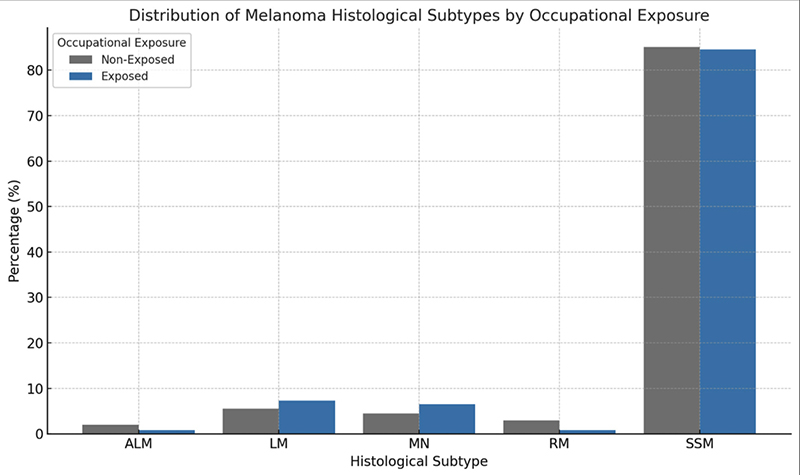
Figure 2.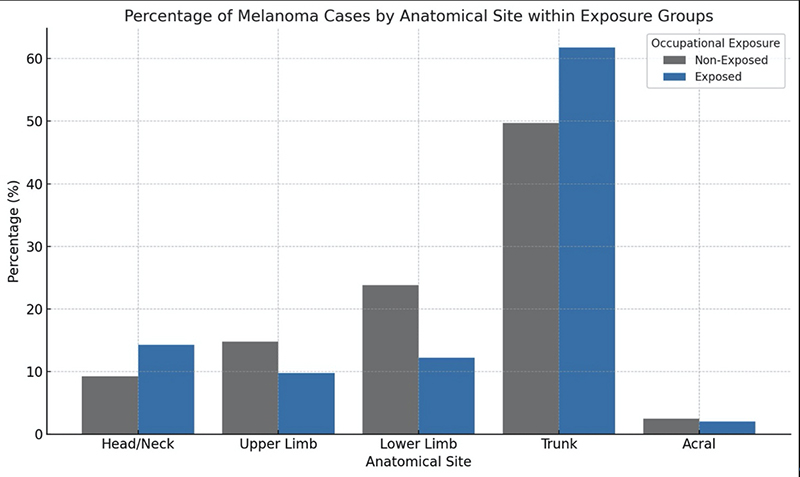
Downloads
Citations



How to Cite

This work is licensed under a Creative Commons Attribution-NonCommercial 4.0 International License.
