



16 | Sentinel lymph node biopsy in elderly patients with melanoma: prognostic value and impact on recurrence
B. Taglione1, I. Mattavelli1, A. Maurichi1, G. Gallino1, D. Cortese1, A. Manfredi1, S. Mercurio1, G. Spadola1, E. Tolomio1, C. Barbieri1, B. Scoppio1, M. Cossa2, B. Valeri2, M. Santinami1, R. Patuzzo1 | 1IRCCS Fondazione Istituto Nazionale dei Tumori di Milano, Melanoma Surgical Unit, Milano; 2IRCCS Fondazione Istituto Nazionale dei Tumori di Milano, Pathology, Milano, Italy.

All claims expressed in this article are solely those of the authors and do not necessarily represent those of their affiliated organizations, or those of the publisher, the editors and the reviewers. Any product that may be evaluated in this article or claim that may be made by its manufacturer is not guaranteed or endorsed by the publisher.
Authors
Background: The role of sentinel lymph node biopsy (SLNB) in elderly patients affected by cutaneous melanoma (CM) remains debated due to comorbidities, surgical risks and especially given the lower SLN positivity rates. The aim of the study was to evaluate the clinical and prognostic value of SLNB in patients aged ≥70 years with localized melanoma stage ≥T1b, compared with younger cohorts.
Methods: We retrospectively analyzed 3129 consecutive patients diagnosed with CM stage ≥T1b between 2001 and 2015 at the National Cancer Institute of Milan. This time window was chosen to avoid the confounding effect of adjuvant therapies. Patients were stratified by age (18–39, 40–69, ≥70 years) and by SLNB execution (yes/no). The ≥70 cutoff was chosen to define the elderly group based on increasing life expectancy and evolving concepts of surgical fitness. Primary endpoints were SLNB positivity rate, recurrence patterns, and survival outcomes. Statistical analysis was conducted using standard univariate tests.
Results: The SLNB procedure was performed in 2898 patients (92.6%) aged ≥70, with a positivity rate of 25%. Among patients ≥70 years, SLNB positivity was significantly associated with adverse pathological features (Breslow >4 mm, ulceration, high mitotic rate, T4b stage, lymphovascular invasion; p < 0.0001) and with a significantly higher risk of loco-regional and distant and higher melanoma-specific mortality (Table 1). While SLNB positivity decreased with age, its prognostic impact was preserved across all age groups.
Conclusions: SLNB remains a valuable prognostic tool in elderly patients as its positivity rate is strongly associated with adverse outcomes. Age alone should not preclude SLNB when clinically appropriate.
Table 1.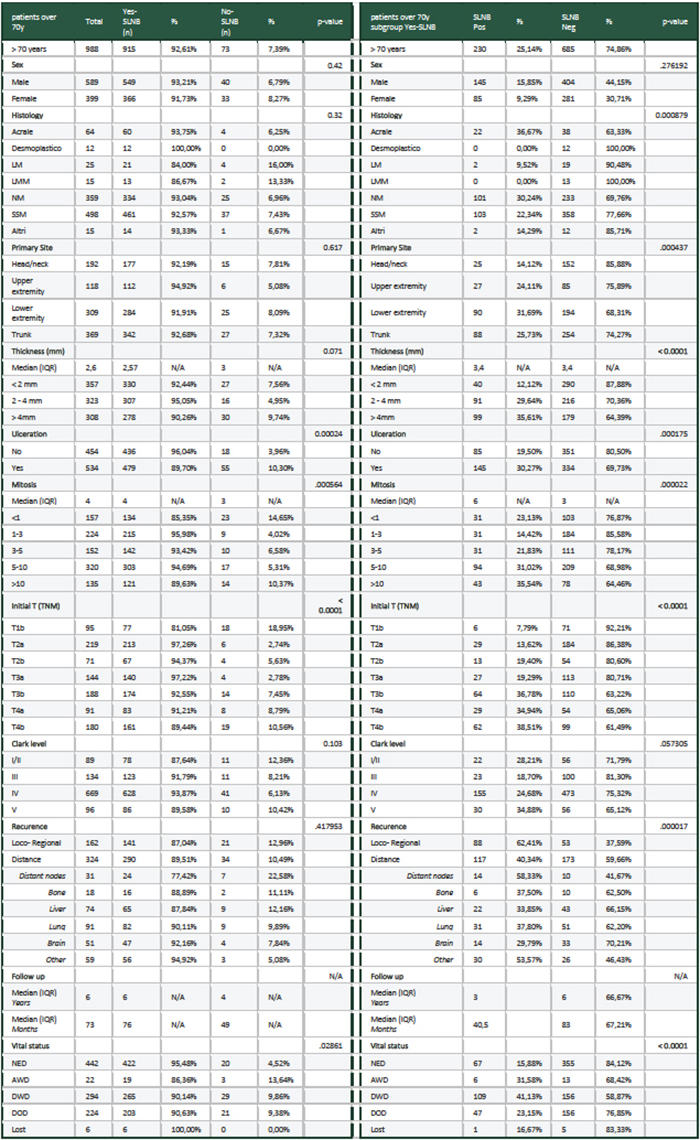
Downloads
Citations



How to Cite

This work is licensed under a Creative Commons Attribution-NonCommercial 4.0 International License.
