



24 | Management of advanced basal cell carcinoma with hedgehog inhibitors: a real-world prospective comparative study
Federico Venturi1|2|3, Biancamaria Zuccaro1, Gabriella Perillo1, Giovanni Cecchi1, Aurora Gaeta4|5, Sara Gandini4, Vincenzo De Giorgi1|6 | 1Section of Dermatology, Department of Health Sciences, University of Florence; 2Oncologic Dermatology Unit, IRCCS Azienda Ospedaliero-Universitaria di Bologna; 3Department of Medical and Surgical Sciences, DIMEC, Alma Mater Studiorum University of Bologna; 4Department of Experimental Oncology, European Institute of Oncology, IRCCS, Milan; 5Department of Statistics and Quantitative Methods, University of Milano-Bicocca; 6Cancer Research "Attilia Pofferi" Foundation, Pistoia, Italy.

All claims expressed in this article are solely those of the authors and do not necessarily represent those of their affiliated organizations, or those of the publisher, the editors and the reviewers. Any product that may be evaluated in this article or claim that may be made by its manufacturer is not guaranteed or endorsed by the publisher.
Authors
Background: Hedgehog Pathway Inhibitors (HHIs) should be offered to patients with advanced BCC as a first line treatment. Two systemic HHIs are currently available: sonidegib and vismodegib. Since there is no head-to-head trial of sonidegib versus vismodegib and very few comparative studies have been published, we aimed at prospectively describing our long-term approach to manage advanced BCC based on our 10 years' experience with HHIs.
Methods: We undertook a prospective, monocentric and descriptive study in Florence, Italy. Patients that were treated with Sonidegib and/or Vismodegib for advanced BCC according to EADO staging system were included from January 2013 to December 2023. Epidemiological, efficacy and safety data were collected.
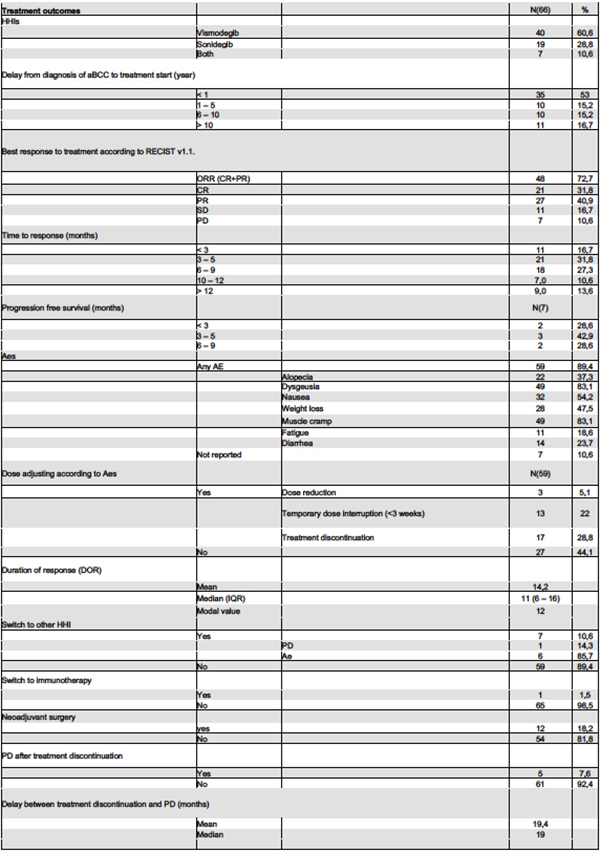
Results: The study population consisted of 66 patients with clinic-pathological confirmed diagnosis of advanced BCC. Of the 66 patients, 40(60.6%) were treated with vismodegib, 19(28.8%) with sonidegib, and 7(10.6%) were switched to sonidegib after vismodegib discontinuation. Among the 40 evaluable vismodegib-treated patients, the ORR was 65%, with CR in 27.5% of cases. DCR was 85%. Among the 19 evaluable patients treated with sonidegib, ORR and CR were 89.5% and 36.8%, respectively. Regarding patients switched from vismodegib to sonidegib (mainly patients who had AEs with vismodegib previously), the ORR was 71.4% with CR in 42.9% of cases (Table 1).
Conclusions: The efficacy demonstrated by Sonidegib is greater than reported in the pivotal studies with an ORR rate of 89.5% (vs 60.6%), a CR rate of 36.8% (vs 22.7%) and PR of 52.6% (vs. 37.9%). Another element of innovation was the analysis of the subgroup of patients switched from Vismodegib to Sonidegib with an ORR of 71.4% (CR 42.9%, PR 28.5%). This, in relation to the possibility of developing resistance during therapy with HHI represents a promising result, suggesting a maintenance of effectiveness of the target therapy even in patients who are not naïve to it.
Table 1.
Efficacy and safety outcomes in the overall study population. HHIs, Hedgehog Inhibitors; aBCC, advanced BCC; ORR, overall response rate; CR, complete response; PR, partial response; SD, stable disease; PD, progression of disease; TTR, time to response; Aes, adverse events; DOR, duration of response.
Downloads
Citations



How to Cite

This work is licensed under a Creative Commons Attribution-NonCommercial 4.0 International License.
