


30 | Sonidegib for nevoid basal cell carcinoma (Gorlin) syndrome and EADO stage IIb sporadic basal cell carcinomas: a phase II study (SIBLINGS trial)
Sara Farinatti1|2, Giuseppe Agenziano3, Emi Dika4|5, Emanuela Passoni6, Ketty Peris7, Pietro Quaglino8, Paola Queirolo9, Massimiliano Scalvenzi10, Iris Zalaudek11, Luigi Lorini11, Cristina Gurizzan1, Monica Variolo1|2, Paolo Bossi*1|2, Carlo Resteghini*1|2 | 1Medical Oncology and Hematology Unit, IRCCS Humanitas Research Hospital, Rozzano, Milano; 2Department of Biomedical Sciences, Humanitas University, Rozzano MI; 3Unit of Dermatology, Luigi Vanvitelli University of Campania, Naples; 4Oncologic Dermatology Unit, IRCCS Azienda Ospedaliero-Universitaria di Bologna, Bologna; 5Department of Medical and Surgical Sciences, DIMEC, University of Bologna, Bologna; 6Dermatology Unit, Fondazione IRCCS Ca' Granda Ospedale Maggiore Policlinico, Milan; 7Institute of Dermatology, Catholic University of the Sacred Heart, Rome; Fondazione Policlinico Universitario A. Gemelli, IRCCS, Rome; 8Dermatologic Clinic, University of Turin Medical School, Turin; 9Medical Oncology Unit; 10Section of Dermatology, Department of Clinical Medicine and Surgery, University of Naples Federico II, Naples; 11Department of Dermatology and Venereology, University of Trieste, Ospedale Maggiore, Trieste, Italy. *Contributed equally.
All claims expressed in this article are solely those of the authors and do not necessarily represent those of their affiliated organizations, or those of the publisher, the editors and the reviewers. Any product that may be evaluated in this article or claim that may be made by its manufacturer is not guaranteed or endorsed by the publisher.
Authors
Background: Nevoid Basal Cell Carcinoma Syndrome (NBCCS), or Gorlin syndrome, is a rare genetic condition characterized by multiple basal cell carcinomas (BCCs). Some sporadic BCC patients present multiple lesions, classified as difficult-to-treat (EADO stage IIb). In this population, surgery and radiotherapy are often unfeasible. Hedgehog-inhibitors (HHIs), such as vismodegib and sonidegib, demonstrated efficacy in advanced BCCs, including NBCCS. Class-specific adverse events (AEs) often lead to treatment discontinuation, limiting long-term benefits. Pulsed treatment schedules mitigate toxicity and improve compliance.
Methods: This is a phase II, single-arm, open-label study evaluating a tailored sonidegib schedule in adults with NBCCS or sporadic EADO stage IIb BCC patients. Eligible participants are aged 18–50, ECOG PS 0–1, HHI-naïve, not candidates for surgery or radiotherapy. Following a 16-week induction phase with daily sonidegib (200 mg), responders enter a 24-week maintenance phase using a pulsed 2:2 schedule (2 weeks on, 2 weeks off - Figure 1). Temporary suspensions (≤3 weeks) and dose reductions are permitted for grade ≥3 AEs. Response is assessed via RECIST at clinical visits, focusing on objective response rate , duration of response, and emergence of new lesions. The primary endpoint is treatment compliance, defined by the discontinuation rate. Secondary outcomes include safety, quality of life, and BCC control. A sample size of 15 patients provides 80% power to detect a reduction in discontinuation from 54% (from literature) to 20%.
Discussion: This study explores whether a planned pulsed dosing strategy can improve tolerability, reducing discontinuation while maintaining clinical benefit. This approach may extend treatment duration, improve quality of life, reduce relapse rates and emergence of new lesions. Limitations include small sample size and slow recruitment, inherent to the rarity of NBCCS and stringent eligibility criteria. Nevertheless, the study could provide valuable insights for optimizing long-term management in these high-need populations. Protocol number: EU CT n. 2024-515989-14-00.
Figure 1.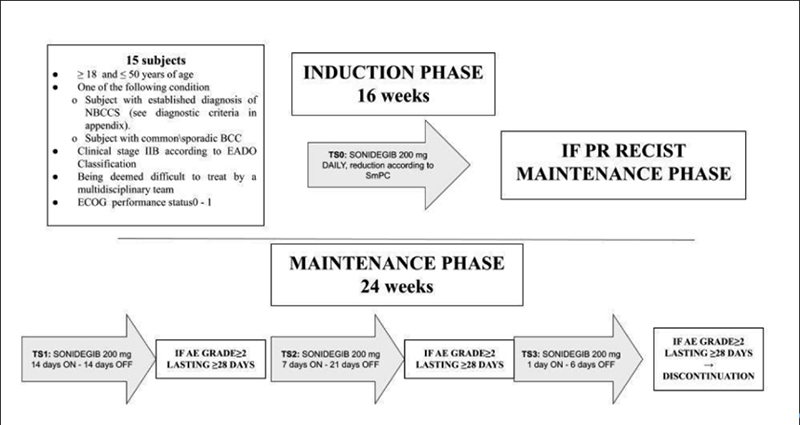
Downloads
Citations



How to Cite

This work is licensed under a Creative Commons Attribution-NonCommercial 4.0 International License.
