


31 | Effectiveness and safety of adjuvant combo-targeted and immunotherapy in melanoma patients
Valentina Salizzato1, Luisa Piccin1, Alessio Fabozzi2, Paolo Del Fiore3, Francesco Cavallin4, Chiara Cacco1|5, Simone Mocellin3|5, Marcodomenico Mazza3, Valentina Guarneri1|5, Jacopo Pigozzo1 | 1Medical Oncology 2, Veneto Institute of Oncology IOV-IRCCS, Padova; 2Medical Oncology 3, Veneto Institute of Oncology IOV-IRCCS, Padova; 3Soft-Tissue, Peritoneum and Melanoma Surgical Oncology, Veneto Institute of Oncology IOV-IRCCS, Padova; 4Independent Statistician, Solagna; 5Department of Surgical, Oncological and Gastroenterological Sciences, University of Padova, Padova, Italy.
All claims expressed in this article are solely those of the authors and do not necessarily represent those of their affiliated organizations, or those of the publisher, the editors and the reviewers. Any product that may be evaluated in this article or claim that may be made by its manufacturer is not guaranteed or endorsed by the publisher.
Authors
Background: Adjuvant combo-targeted therapy (TT) and immunotherapy (IT) reduced relapse risk (HR=0.50) in fully resected stage III melanoma, without improving overall survival (OS). Real-world data are crucial to assess their effectiveness and safety in clinical practice, considering also the absence of head-to-head trials.
Methods: Single-center retrospective study evaluating effectiveness and safety of adjuvant TT and IT in completely resected stage III melanoma patients administered between 2020-2025. Baseline patient characteristics, relapse-free survival (RFS), distant metastases-free survival (DMFS), OS, and treatment discontinuation were analysed.
Results: Out of 218 patients, 41.7% received at least one dose of adjuvant IT, while 58.3% were treated with TT. Baseline patient characteristics are summarized in Table 1. Median follow-up was 37 months (IQR 20-58). At the data cut-off, 83.9% of patients were alive and 29.4% relapsed. Most patients (78%) regularly ended the treatment, while discontinuation due to relapse or toxicity occurred in 9.2% and 8.7% of cases, respectively. Recurrence during treatment resulted more frequently in the IT cohort compared to those receiving TT (17.6%-3.1%, p<0.001). RFS and DMFS rates at 1, 3 and 5 years were higher in patients treated with TT, as was OS (p<0.05). Subgroup analysis further confirmed the OS advantage of TT in stage IIIC-D patients (p=0.03). mRFS, mDMFS and mOS were not reached. Even if not statistically significant, possibly due to limited sample size, preliminary analyses in V600E vs V600K patients treated with TT showed a trend in RFS (77% vs 50%) and OS (90% vs 61%).
Conclusions: Our study suggested improved RFS and OS rates for TT respect to IT. In absence of direct comparison trials, a larger cohort of patients and additional baseline differences-adjusted analyses are needed to properly compare the real-world adjuvant strategies.
Table 1.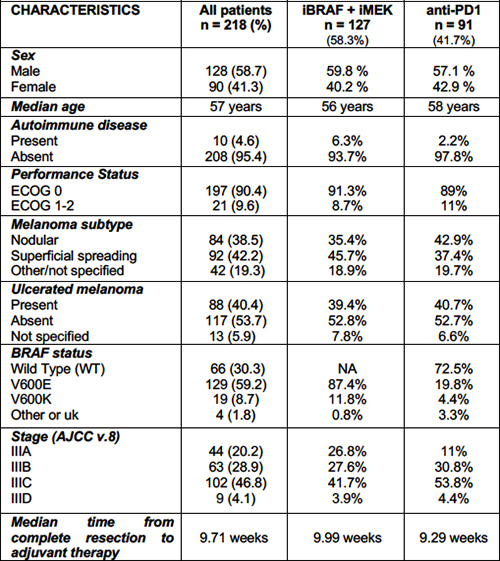
Downloads
Citations



How to Cite

This work is licensed under a Creative Commons Attribution-NonCommercial 4.0 International License.
