



35 | Real-world outcomes of targeted therapy in stage IV melanoma after relapse on adjuvant dabrafenib and trametinib: insights from a single-center cohort
Rossella Villani, Chiara Bungaro, Anna Cecere, Ileana De Roma, Sabino Strippoli, Michele Guida | Rare Tumors and Melanoma Unit, IRCCS Istituto Tumori "Giovanni Paolo II", Bari, Italy.

All claims expressed in this article are solely those of the authors and do not necessarily represent those of their affiliated organizations, or those of the publisher, the editors and the reviewers. Any product that may be evaluated in this article or claim that may be made by its manufacturer is not guaranteed or endorsed by the publisher.
Authors
Background: Adjuvant dabrafenib and trametinib (DT) reduce relapse risk in stage III BRAF-mutant melanoma, but data on recurrence patterns and management after relapse remain scarce. We evaluated recurrence features and outcomes of subsequent therapies in a real-world cohort, focusing on the impact of prior adjuvant treatment on response to metastatic targeted therapy (TT).
Methods: We retrospectively analyzed 51 stage III patients treated with adjuvant DT, assessing RFS, treatment duration, toxicity, and relapse patterns. Additionally, outcomes of 167 stage IV patients (158 treatment-naïve, 9 previously exposed) receiving TT were evaluated with a focus on RR and PFS.
Results: In the adjuvant cohort median age was 60 years and there were 35% female. Six patients (11%) discontinued adjuvant therapy early due to toxicity. Fourteen patients (27%) relapsed—one during treatment and the remainder at a median of 6 months after completing DT; two were local recurrences. Among 12 relapsed stage IV patients, lungs are the most common relapse site (50%), followed by liver and skin (33%). First-line therapy consisted of PD-1 inhibitors (alone or in combination) in 50% of patients and TT in the remaining 50%. Six patients received second-line treatment, including TT in three cases. In adjuvant-exposed patients, TT achieved an ORR of 77% and a median PFS of 7 months, compared with an ORR of 88% and median PFS of 15 months in treatment-naïve patients (Figure 1).
Conclusions: Consistent with previous reports, TT showed reduced ORR and significantly shorter PFS when administered at relapse following adjuvant DT. Standardized data collection and prospective studies are needed to clarify whether a minimum interval from completion of adjuvant therapy is required to restore treatment efficacy.
Figure 1.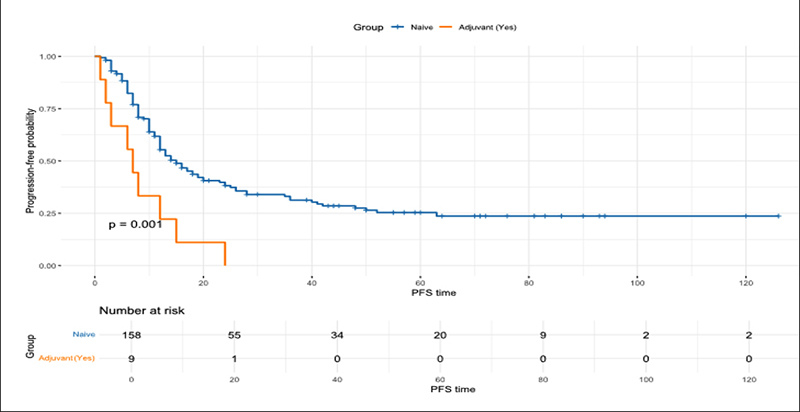
Downloads
Citations



How to Cite

This work is licensed under a Creative Commons Attribution-NonCommercial 4.0 International License.
